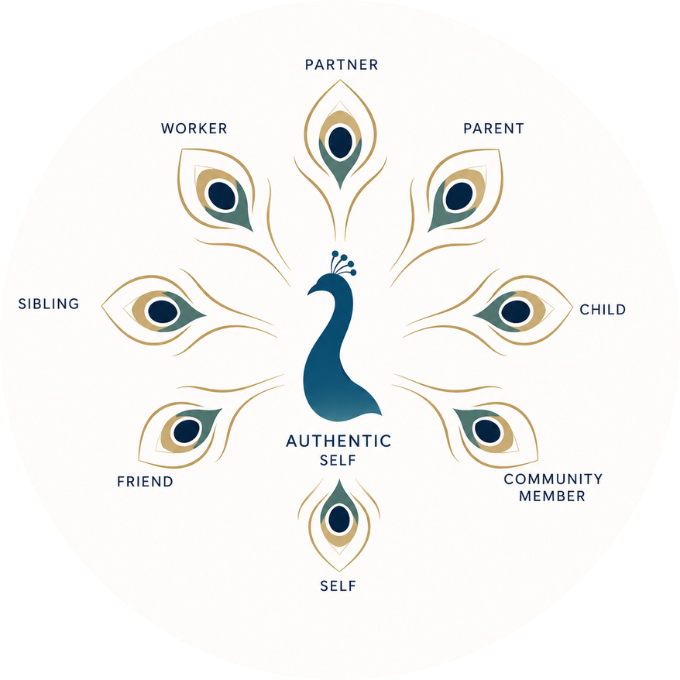
The peacock fans its feathers to be seen a certain way. But the display is not the bird.
Each feather represents a role we play - worker, leader, parent, partner, sibling, friend, community member, and self. In every one of them we curate how we appear. We know what we want people to think of us. And if we're honest, we know what we're working hard to hide.
This framework walks you through four stages of honest self-reflection across each of those roles. It doesn't ask you to be hard on yourself. It asks you to be honest. And then it helps you take real, observable action to close the gap between who you hope to be and who others actually witness.
Sign in to begin - and to save your answers privately as you go. You can return to your work at any time, on any device.
Your answers are completely private. They are saved to your account only - not even the creator of this framework can see them. This is enforced at the database level, not just a promise.
On vulnerability, authenticity and the courage to become who you hope to be
Grounded in The Being Framework · Ashkan Tashvir · Human Being, Engenesis Publications 2021
Most of us carry a carefully managed version of ourselves into the world. We know what we want people to think of us. And if we're honest, we know what we're working hard to hide.
What we rarely stop to ask is whether the gap between those two things is visible to the people around us - and whether it's costing us something.
This framework doesn't ask you to be hard on yourself. It asks you to be honest. There is a difference. And it works across every area of your life, because the masks we wear look different depending on the role we're playing.
The critical shift happens between Stage 1 and Stage 2. Stage 1 is about your intentions and your hopes. Stage 2 forces you to set those aside completely and look only at what you have actually demonstrated.
Not what you meant to do. Not what you were trying to show. What did they see?
What do I want people to think? What am I working to hide?
This is where you look at the gap between your public self and your private self. Not with judgement - with curiosity.
The two questions that open this stage are deceptively simple. Most people can answer them quickly. It is the third that slows everything down.
"How do I WANT people to describe me? What do I NOT want them to think? And would my inner knowing agree - or is there a gap?"
In Ashkan Tashvir's Being Framework, an unhealthy relationship with vulnerability means we are more concerned with being seen to do the right things than actually doing them. We project a version of ourselves we consider more acceptable - and the energy that takes is enormous. This stage simply asks you to notice that. No action required yet. Just honesty.
Not what you intended. What did they actually see?
This is the most confronting stage - and the most important. Here you step completely out of your own perspective and into the perspective of the people in your life.
"What actions and behaviours have I actually shown that give them evidence I am who I hope to be? And what actions might tell a different story?"
This is not about being harsh on yourself. It is about recognising that other people can only respond to what they witness. Our intentions are invisible to them. Our actions are not.
No defending. No explaining. Just - is there a gap?
Authenticity, in the Being Framework, is about the alignment between your self-image - who you know yourself to be - and your persona - who you choose to project to others.
Stage 3 is simply about sitting with what you have discovered in Stages 1 and 2 and asking: is there a gap? How big is it?
"The discomfort you feel at this stage is not a problem. It is the whole point."
That discomfort is the moment where you stop managing perception and start considering change.
Not intentions. Actions. Things that can be seen.
Integrity is not a moral judgement. It is simply the state of being whole and complete - of your actions being consistent with who you say you are.
This is the difference between authenticity and integrity. Authenticity is seeing yourself clearly. Integrity is living it. You need both - and they always come in that order.
"If someone filmed me for a week in this role - what would they actually see that proves I am who I say I am?"
That camera test is everything. A camera cannot film an intention. It can only film what you actually do. So Stage 4 breaks your actions down into three layers - because the people around you are watching all three, whether you realise it or not.
Work through each section below. You don't have to complete all of them in one sitting. Some roles will resonate more than others right now. Start where the pull is strongest.
The example shown in italics under each question is there to show you the kind of answer it is looking for - not to put words in your mouth. Your answers will be your own.
If someone filmed you at work for a week - what would they actually see that proves you are the professional you say you are?
If your team watched you lead this week - what would they actually see that proves you are the leader you say you are?
If your parents watched how you showed up in this relationship this week - what would they actually see that proves you are the son or daughter you hope to be?
If your siblings could see how you showed up in this relationship this week - what would they actually witness that proves you are the brother or sister you hope to be?
If your partner watched how you showed up in this relationship this week - what would they actually see that proves you are the partner you say you are?
If you watched your own daily habits and choices this week with complete honesty - what would you actually see? What would the evidence say about who you are being to yourself?
Every other mask has an audience. This one doesn't. There is no reputation to manage here, no perception to curate. This is the inquiry that strips everything else away.
Look back across the roles you have worked through. There will be a theme in what you most want to hide. There will be a recurring gap between what you intend and what you have shown. There will be one or two roles where the gap is bigger than you expected.
Those are not things to feel bad about. They are the places where your growth is waiting.
"Authenticity is seeing yourself clearly. Integrity is living it. You need both - and they always come in that order."From Mask to Meaning
